Ideology · 2026
On 10 May 2026, the people of Tamil Nadu installed TVK's mandate as government. Chief Minister Vijay now governs on a single principle: everyone deserves everything. Public services without a middleman. Policies without political interference. A state working for the people, with the people, as one among the people. The ideology is no longer a promise — it is operational.
“Work! Rise! You Can!”
The Core Philosophy
TVK's governing ideology — Mathasarpatra Samuga Neethi — operates as a three-tier system designed to deliver equitable governance to every section of Tamil society.
Pirappokkum Ella Uyirkkum
The Thirukkural-rooted principle that all life is equal at birth. In governance, this translates to proportional representation — every section of society holds a stake in power commensurate with its population. No community left behind.
Inclusive Neutrality
The state protects all faiths and remains ideologically independent of any single religious or anti-religious dogma. TVK's secularism is active — not passive indifference, but a positive commitment to equal dignity across all belief systems.
Elected Mandate is Supreme
Education must be moved from the Concurrent List back to the State List. The Governor's post — an unelected override on a democratically elected assembly — must be abolished. Tamil Nadu's elected mandate is supreme.
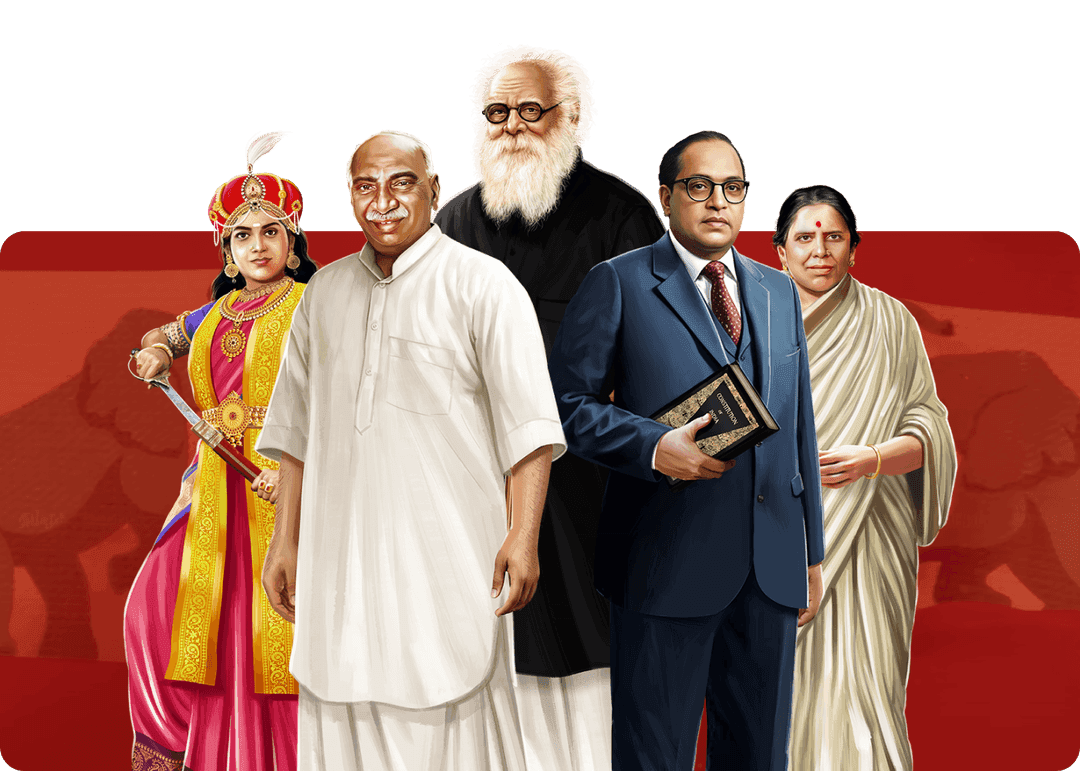
Ideological Icons
TVK's ideology draws directly from five historical figures whose work defines the party's social, constitutional, and educational commitments.
Social Reform · Rationalism · Caste Eradication
The foundational influence for TVK's rationalist mindset and caste-abolition mandate. Periyar's self-respect movement is the living basis for the party's rejection of untouchability and blind tradition.
Constitutional Rights · Legal Equality · Proportional Representation
Ambedkar's constitutional legacy underpins TVK's proportional representation demand and the legal equality pillar. Every TVK policy on reservation, rights, and dignity traces back to the constitutional framework he built.
Educational Revolution · Transparent Administration
The architect of Tamil Nadu's mid-day meal scheme and school expansion. TVK's 100 Kamarajar Special Residential Schools directly invoke his legacy. His model of transparent, incorruptible administration is the template for TVK governance.
Women's Empowerment · Spirit of Resistance
India's first queen to take up arms against colonial rule. Her legacy anchors TVK's women's empowerment agenda and the party's 33% reservation commitment — resistance as governance, courage as policy.
Tamil Nationalism · Working-Class Rights
The labour and Tamil rights activist whose sacrifice represents the working-class foundation of the party's social justice platform. TVK carries forward her commitment to dignity for every labourer and community.
TVK is the first major Tamil party to place two women — Rani Velu Nachiyar and Anjalai Ammal — as primary ideological anchors, not footnotes. Periyar grounds the rationalist and caste-reform mandate. Ambedkar provides the constitutional equality architecture. Kamaraj supplies the governance model. Together they span social reform, constitutional rights, education, women's resistance, and working-class labour — the five dimensions that form Secular Social Justice. No single dimension is optional.
Twelve Ideological Pillars
Adopted at the General Council, Vikravandi, 28 March 2025. Twelve chapters — each a formal commitment of the party, each linking ideology to governance.
01
Equal rights without discrimination; opposition to state suppression of fundamental freedoms.
Read chapter →02
Proportional representation across all sectors until caste eradication is achieved.
Read chapter →03
Rights spanning caste, religion, gender, disability status, and economic class.
Read chapter →04
Secular governance treating all faiths and non-believers equally.
Read chapter →05
Abolish the unelected Governor override; move Education from the Concurrent List to the State List; reclaim federal rights designated to Tamil Nadu.
Read chapter →06
Tamil and English only — a firm rejection of Hindi imposition, anchored in the legacy of the Anti-Hindi agitation.
Read chapter →07
Corruption-free governance ensuring education, healthcare, water, and clean air as fundamental rights.
Read chapter →08
Rejecting ideas harmful to human well-being.
Read chapter →09
Eradicating regressive traditions perpetuating discrimination.
Read chapter →10
Development balancing regional growth with ecological preservation.
Read chapter →11
Eliminating intoxicants damaging productivity and health.
Read chapter →12
The synthesising principle: individual, social, economic, and political rights for every citizen — free from divisive categorisation by caste, religion, or class.
Read chapter →21st Century Good Governance
The 2026 mandate translates the ideology into concrete, time-bound programs — each with a delivering department and financial commitment.
A No Power Centre policy: public services delivered without political interference. The Vetri TN Super App and Citizen Privilege Card ensure all certificates, benefits, and entitlements reach citizens in 21 days — without a middleman.
Read chapter → →Tamil Nadu's GDP target: $1.5 Trillion by 2036 through decentralised industrialisation, 5-year tax-free electricity for MSMEs, a ₹15,000 crore MSME guarantee fund, and AI universities anchored in every zone.
Interest-free education loans up to ₹20 lakh (Class XII to PhD). Abolition of NEET. 100 Kamarajar Special Residential Schools. ₹4,000 monthly for unemployed graduates and 5 lakh annual internships to bridge the employment gap.
₹25 lakh health insurance per family. ₹2,500 monthly financial assistance for women heads of households. Free higher education for children of small and marginal farmers. A floor of dignity — not charity — guaranteed by the state.
Frequently Asked
Secular Social Justice — Mathasarpatra Samuga Neethi — is TVK's governance model that ensures equitable opportunities for all citizens regardless of caste or religion, while maintaining a state that is neutral toward faith but active in social reform. It combines proportional representation, constitutional equality, and rationalist governance.
TVK advocates for the total abolition of NEET, holding that it discriminates against Tamil Nadu's state-specific merit system. The party demands that Education be moved from the Concurrent List to the State List — restoring Tamil Nadu's sovereign right to design curricula and admissions for its own students.
TVK is committed to 33% reservation for women in both party leadership and legislative appointments. Women's safety, economic independence, and political representation are primary governance pillars — not add-ons. The ₹3,000 monthly pension and ₹25 lakh health cover are structural commitments, not welfare gestures.
The Governor is an unelected appointee of the Union Government — not chosen by Tamil Nadu's electorate. TVK regards the post as a structural mechanism for central interference in a state with its own democratic mandate. Abolishing it removes the single most significant unelected override on the elected assembly, ensuring that the people's mandate, not New Delhi's appointment, governs Tamil Nadu.
TVK strictly adheres to the Two-Language Policy — Tamil and English as Tamil Nadu's only official languages. The party firmly rejects Hindi imposition, citing the legacy of the 1937–40 Anti-Hindi agitation in which Tamil Nadu's people resisted central language policy by force. Hindi in government or education is a cultural imposition on Tamil-speaking citizens who never consented to it. TVK also invests in Tamil computational infrastructure — fonts, voice models, machine translation — to prevent digital governance from becoming a back-door for Hindi.